$ cat /projects/dynamical-systems.md
Dynamical Systems Emulation
A neural network can match a chaotic system's next state while getting its dynamics wrong. Eight diagnostics show where.
Brief
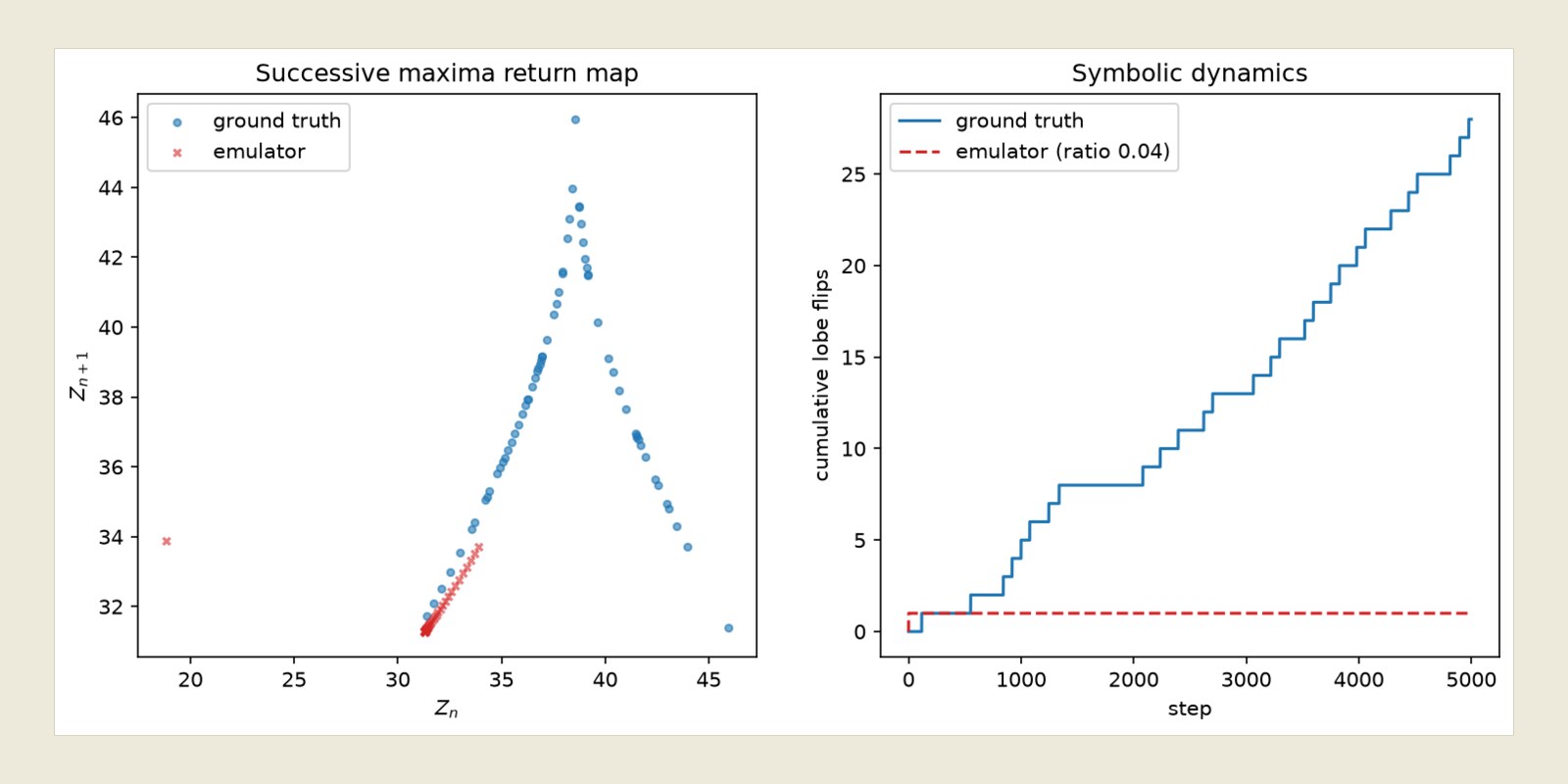
Can a neural network learn a chaotic system’s dynamics, or only its next state? The difference is easy to miss: a model can predict the next step almost perfectly and still erase the chaos that makes the system interesting.
Approach
I trained a small emulator on the Lorenz-63 equations and measured it with eight trajectory diagnostics — Lyapunov spectra, correlation dimension, DMD, volume contraction, lobe statistics — instead of forecast error. The model is an Equinox MLP in JAX, trained against an RK4 integrator with analytic Jacobians.
What I found
One-step error barely notices dynamics. The trained emulator produced a dominant Lyapunov exponent of −0.01 against a true +0.88, and contracted volume 22 times too fast. The failure is structural: volume change enters a one-step prediction only at second order in the timestep, so next-state loss has almost no reason to learn it. Measuring the right thing made the failure visible; putting the divergence in the loss pulled contraction back to within 1%.