$ cat /projects/movement-gym.md
Movement Gym
A first-person movement sandbox where "does it feel good?" is measured instead of argued about.
Brief
Movement feel is usually tuned by vibes and defended in conversation. I wanted a gym where the numbers behind the feel — acceleration, jump apex, dash count, slope behaviour — could be measured and regression-tested before a change shipped.
Approach
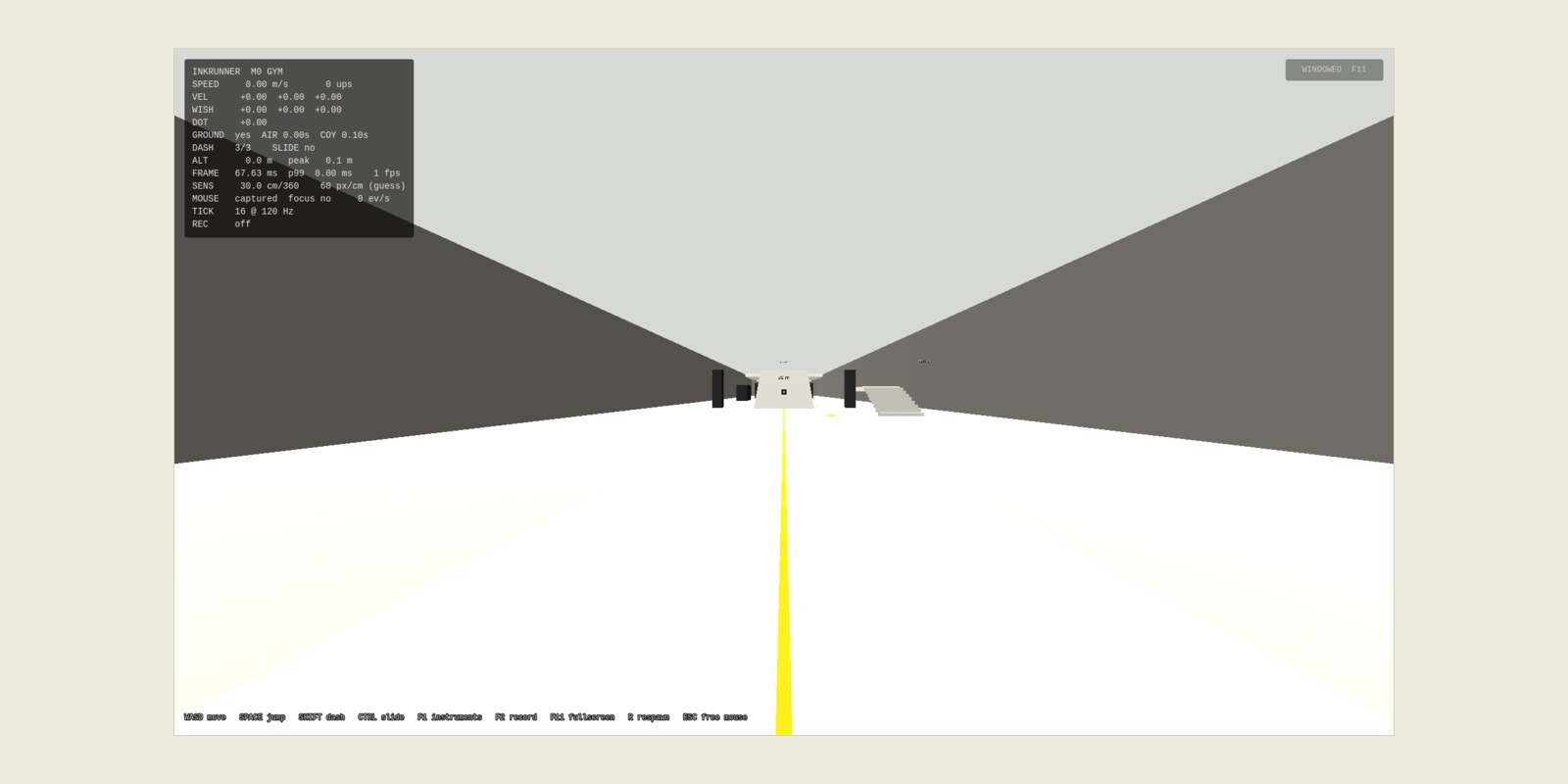
The gym is a small Godot project with a custom collide-and-slide loop instead of move_and_slide(), so velocity and floor state stay under the code’s control. It implements Quake-style acceleration and friction, coyote time, jump buffering, a three-charge dash, slide, step-up, and floor snapping. Telemetry records speed, wish direction, grounded and air time, dash charges, altitude, and frame time; F2 writes a CSV.
Four headless test scenes cover movement math, look input, the gym geometry, and acceptance numbers such as 0→7.9 m/s in at most 0.25 s and a jump apex of 1.19 ± 0.06 m.
What I learned
Making feel testable does not make it mechanical. The tests catch regressions, but the useful work is building the instrumented gym in the first place: once you can see the numbers while moving, tuning stops being a memory exercise.